

Two Weeks on a Jury
What a felony murder case showed me about how people decide hard things together

I spent two weeks as a juror on a felony murder case. I won’t say much about the specifics, but the charge was serious, the evidence was contested, and the deliberation was hard. We ultimately convicted.
I’ve sat in plenty of high-stakes rooms over the years. Budget reviews, reorgs, performance conversations, strategy fights and this was not like those. The stakes were heavier, the decision was permanent, and somehow that made everything about how a group of people reasons together easier to see.
Some doors only go one way
We talk a lot about one-way doors and two-way doors at work. A two-way door is a decision you can walk back. A one-way door you can’t. Most of our cleverness goes into turning one-way doors into two-way doors: building in pivot points, phasing rollouts, keeping our options open. Usually that’s the right instinct.
Then you sit in a deliberation room and feel an actual one-way door close. A conviction follows someone for the rest of their life. There’s no retro, no pivot, no version two. That permanence sat on every piece of evidence I looked at and every moment of doubt I had.
Jeff Bezos gets credit for naming this, Type 1 versus Type 2 decisions, and his point was that companies get into trouble when they run both types through the same fast process. A jury is the opposite because it’s a process built entirely for the one-way door. Structured, slow, consensus-bound, with a clear bar for what counts as enough.
Most leadership teams have nothing like that for their heaviest calls. We’ve gotten so good at manufacturing two-way doors that we forget some decisions were never reversible to begin with. Letting someone go. Pulling apart a team. Trust, once you’ve spent it.
A test I’ve started using: imagine trying to undo this a year from now. If the honest answer is “we can’t,” treat it like the one-way door it is and slow down on purpose.
Quiet is not agreement
Put twelve people in a room and the pressure to converge shows up fast. People naturally want to agree. They want to go home. Standing alone against the other eleven is harder than almost anything we manufacture at the office. Twelve Angry Men is famous for a reason.
I watched that play out and kept thinking about every meeting where I’d read silence as buy-in. When someone goes quiet, you have no idea whether they came around or just gave up. A room that stops arguing might be aligned, or it might be exhausted. Those look identical from the head of the table and they behave nothing alike afterward.
Did the people who disagreed actually change their minds, or did they fold? The one who folded won’t fight for the decision when it gets hard. They’ll hedge. And they tend to resurface the old objection at the worst possible moment.
The cheapest fix I know is to make room for dissent before you close. “What would have to be true for this to be the wrong call?” works. So does turning to the quietest person at the table and asking them straight.
What looks like an argument is sometimes grief
This one caught me off guard, and I think it matters most for anyone who leads people through hard things.
Stretches of our deliberation looked like conflict from the outside. People pushing back, voices going tight, the verdict starting to feel like it might hang. However, it wasn’t really a fight about the evidence. People were carrying the weight of deciding something that would change another human being’s life, and that weight had to go somewhere.
Nobody warned us this would happen or named it in the moment. But once I saw it for what it was, my mindset changed. The friction had never been about the facts. It was about the burden of using them.
We get this wrong all the time as leaders. Friction shows up in a hard conversation and we treat it as a thinking problem. We answer with more data, sharper arguments, or a cleaner framework. What people actually needed first was someone to say out loud that this is heavy.
Plenty of decisions are hard for reasons that have nothing to do with whether the answer is clear. They’re hard because the cost is real and people feel it. The teams that handle those moments well are the ones that let the weight exist instead of rushing to clear it off the table.
Set the bar before you start
The standard for a conviction is “beyond a reasonable doubt.” High bar, on purpose. What struck me in the room was how much of our argument was really about what that phrase meant, not about the facts in front of us. Everyone had quietly imported their own threshold for how sure is sure enough, and the distance between those private thresholds is where most of the friction lived.
Same thing happens at work constantly. A team debates a call for an hour without ever settling what “enough evidence” looks like. So the bar gets set after the fact, in the moment, usually by whoever’s most insistent.
Name it first. “We move if we get two solid data points and one customer willing to vouch for it.” “We don’t expand until it works in a single market.” A standard you agree to before the debate is far harder to quietly slide around than one you reach for halfway through.
Does it hold up without you in the room?
A jury gets handed the written law and told to apply it. In our case the judge read the instructions aloud and gave us a copy to take back with us. I assumed that was plenty, but it wasn’t.
When we hit a question about what specific language actually meant, we asked. Word came back that interpreting it was the jury’s job and the judge couldn’t help us. That genuinely surprised me. I’d never understood that part of what a jury does. The instructions were the only guide and from there we were on our own.
It was clear that smart people had worked to make those instructions readable. Obscurity wasn’t the issue; nuance was. Take a word like “malice.” It has a precise legal meaning on the page, but twelve people walked in with twelve lived versions of that word in their heads, and those don’t line up automatically. We had to grind through what it meant against the written standard with no one available to tell us whether we’d landed in the right place.
I’ve done the leadership version of this more times than I’d like to admit. You build the strategy, write the note, deliver it at the all-hands, and walk out. You made the effort. You wrote it down. You said it out loud. Then the team carries it into their own version of a deliberation room and has to decide what you meant, apply it to situations you never saw coming, and make calls you assumed were self-evident.
The breakdown often isn’t in how clearly you communicated. It’s buried in the words. A phrase that feels exact to whoever wrote it lands differently depending on who’s holding it. “Customer-first” reads one way to someone out of product and another way to someone out of operations. “Move fast” means something different at every level of the org.
Your team can ask you to clarify, but a lot of them won’t. They’ll assume they got it, they won’t want to look lost, or they’ll quietly judge the question not worth the risk of asking. Either way you end up where our jury did, with your strategy interpreted in your absence and the spread between those interpretations a lot wider than you’d guess.
The question I now sit with isn’t “did I communicate this?” It’s “does this still mean what I intended once I’ve left the room?”
You don’t need authority to lead the room
A jury foreperson has almost no real power. Can’t compel anyone, can’t override a vote, can’t add an hour to the clock. The effective ones lead anyway, through structure. They name what’s actually in dispute. They pull factual questions apart from judgment calls. They keep everyone arguing about the criteria instead of just relitigating the verdict.
I watched someone do exactly that. He never pushed hard for a position. He asked the clarifying question. When we started going in circles he named the specific thing we disagreed about. He suggested a way to work through the evidence rather than just running at it again.
That’s a real skill and it’s badly undervalued, because it reads as process rather than leadership. Organizations hand the credit to the person who argued loudest for the winning side. The person who built the conditions for a good decision usually walks away without anyone noticing what they did. Don’t overlook the critical role of a good program manager, facilitator, and change manager in your organization.
People are mostly good, and they’ll do hard things together
There’s an odd two-sidedness to jury duty. The case drags you through the worst of things: days of harm and conflict and people at their lowest. That part is heavy and it stays with you.
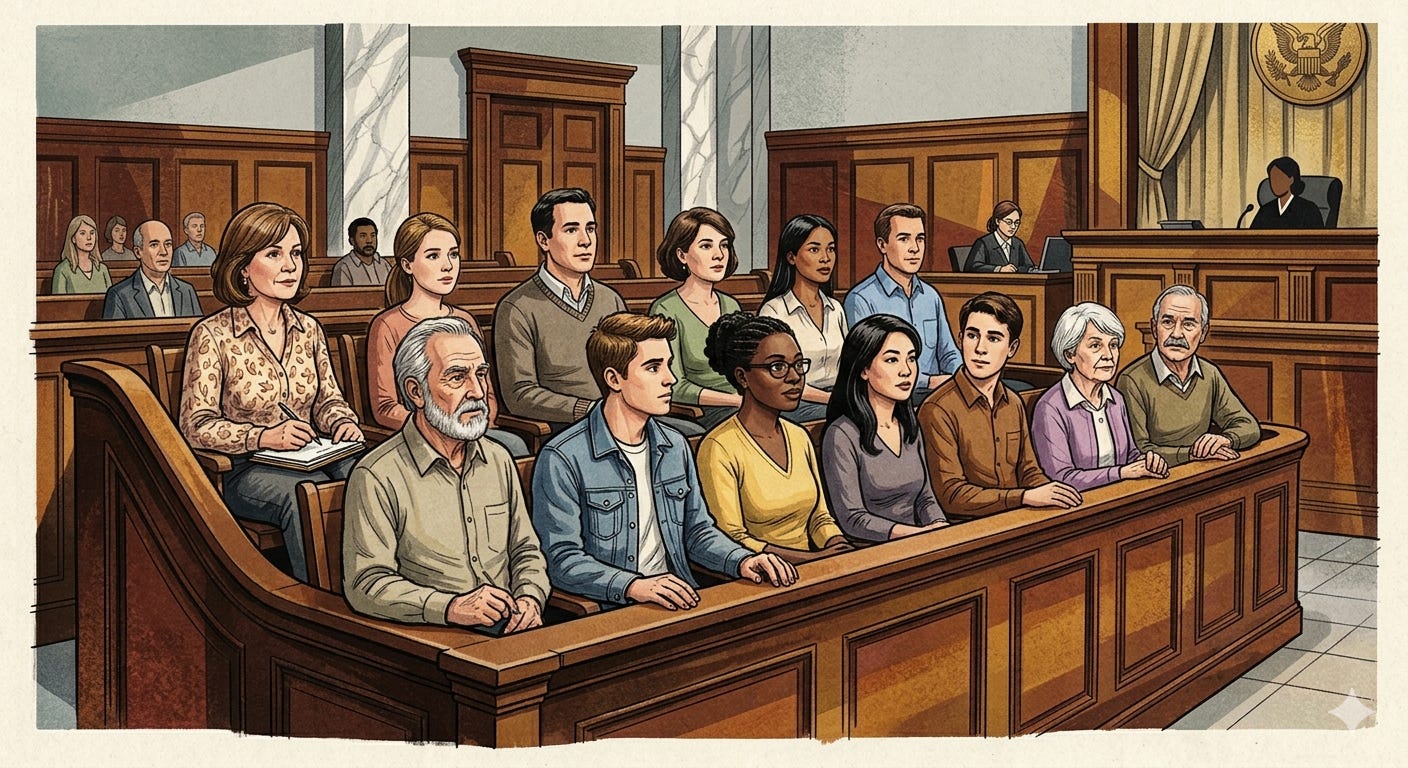
Running right alongside it is the other thing though: Twelve strangers with different jobs, different backgrounds, no shared history, sat down together and did something genuinely difficult. They took it seriously, challenged each other, and stayed in the discomfort instead of bolting from it. And they arrived somewhere none of them could have reached alone.
I left more reassured about people than I expected to. Not starry-eyed about it, just reminded. Give people a real responsibility and a real stake in how it turns out, and most of them rise to it. That’s worth hanging onto in a leadership job, where it’s easy to let the hardest cases quietly become your whole picture of what people are.
That room was also a plain reminder that working across difference isn’t only a nice thing to say in a values deck. It works. People don’t have to be alike to do hard things well together.
I don’t know if I’ll get summoned again. But I left that courthouse with a real respect for what structured deliberation is, and a sharper sense of everything we skip when we make hard calls without it.