

"I want a job like yours someday" is not a career goal.
Here is how to find one.

Ask any team about what is missing and career growth shows up near the top. It has in every employee survey I have ever read, across companies and industries and team sizes. It is one of the most consistent signals in organizational life, and one of the hardest to actually do something about.
My version of a career development conversation, for most of my career as a leader, went something like this. I would ask someone where they wanted to be in a few years. They would say something like “I want a job like yours someday.” I would nod, try not to let on that this was not actually a useful answer, and we would spend the rest of the time talking about how to get from their current level to the next one.
Those conversations were not bad. They were just narrow. Almost every one of them was really a scope conversation: how do I get from specialist to manager, or manager to director? Which is fine, except that those immediate scope moves are exactly what a specialist looks like. They signal someone who has done one thing well for a long time and wants more of the same, just bigger. That is not what ambitious careers are built on.
The deeper problem was that when I tried to suggest lateral moves, people did not know what to do with the advice. “Take a lateral role” is vague in the same way “eat healthier” is vague. It gestures at the right idea without giving anyone anything to do. And when people said they wanted a job like mine one day, what they usually meant was the pay or the title. Not the specific combination of market experience, discipline breadth, and organizational complexity that actually produces that kind of role.
Here is what I eventually understood: most people cannot picture what a different version of their career actually looks like. Not because they lack ambition, but because they have no tool for generating options. When you cannot imagine a concrete alternative, deepening what you already know feels like the safest answer. Specialization becomes the default not because it is the right choice, but because it is the only choice that feels visible. They did not have a real target. They had a sentiment, and a comfort zone that looked like a strategy.
I did not have a better answer for a long time. Then I started showing people my own map, including the gaps. That is when the conversations changed.

The map is simple in concept: every role you have ever held, described across a consistent set of dimensions, laid out across time. Here is what mine looks like across 25 years.
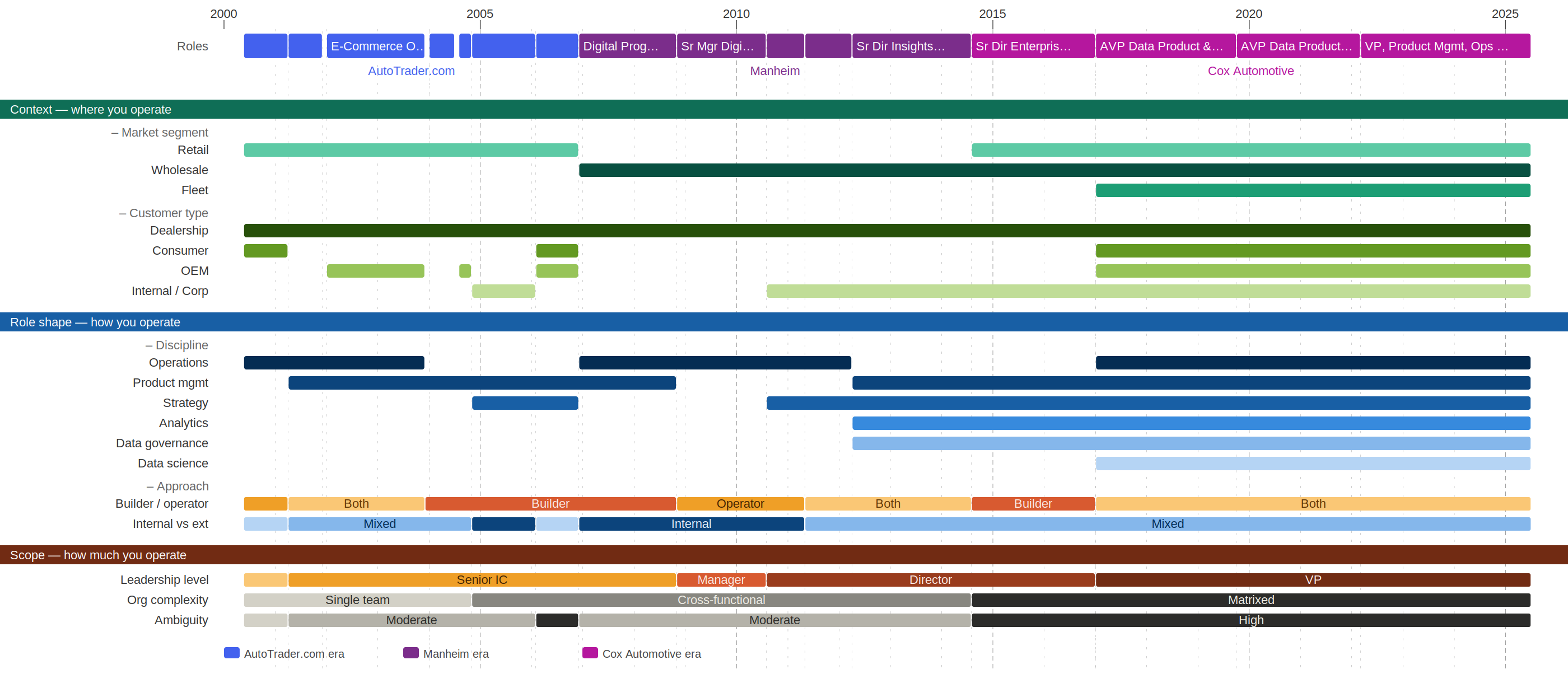
I spent the first six years at AutoTrader.com entirely in retail automotive. Seven roles that mostly shifted one or two dimensions at a time. I understood digital retail deeply. I had no real understanding of wholesale automotive, which is where the majority of vehicle transactions actually happen. The vehicle lifecycle does not begin and end at the dealership. I had been missing the most active part of it for six years without knowing it.
In 2006 I moved to Manheim to work on digital wholesale. It was a scary move. I knew the work would draw on the product management and digital expertise I had built. I also knew some of the leaders there, which helped. But it was a massive change: different market, different customers, different rhythms, different vocabulary for how the business worked.
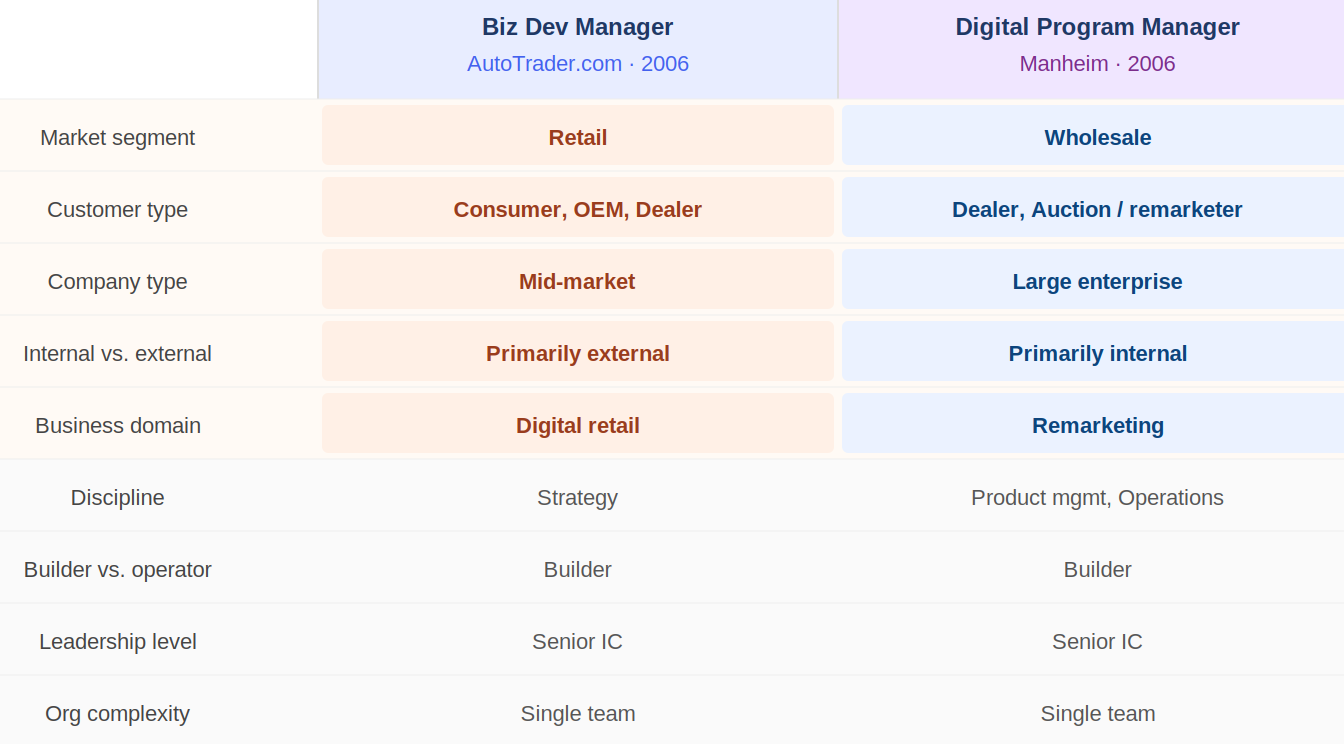
Five dimensions shifted simultaneously. A framework I did not yet have would have flagged this as high risk. It was. The adjustment period was real. But it was also the most productive growth period of my career. Eight years later I had added analytics, data governance, P&L ownership, people management at scale, and an entirely new business domain to a foundation that had been almost entirely product and operations. None of that was available to me inside retail.
And then there is the dimension that has never moved.
Industry is the one entry on my map that looks identical from 2000 to today. Everything else has shifted. This one has not. I did not set out after college to spend 25 years in automotive. But I have found the industry more genuinely fascinating than I expected, and more meaningful. Dealerships play important roles in their local communities, which sounds like a talking point until you actually spend time with dealers and realize it is just true. Trust is a persistent complaint about the industry, which means the work of building more consistency and transparency is a problem worth solving. One that helps people I know.
Still: I sit with that dimension honestly. It may be the right choice. It may be expertise I have rationalized into a reason not to try something else. Both things can be true simultaneously.
Showing that map to someone, including the uncomfortable part at the end, changed what they were willing to say in response. The conversation stopped being advice from the top. It became two people looking honestly at what careers actually ask of people over time. Nobody feels coached when a senior leader is presenting frameworks at them. People feel something different when a senior leader is thinking out loud alongside them.
Once you have a map, the practical constraint is simple: aim to change one to three dimensions in any given move.
The dimensions group into three categories. Some describe context or where you operate: what market you are in, who your customers are, the type and size of company, whether the organization is in startup mode or mature. Some describe role or how you operate: whether you are an individual contributor or managing a team, whether your work faces internal or external stakeholders, the craft you practice, whether you are building something new or running something that already exists. And some describe scope or the scale of what you operate: your title, team size, budget ownership, how complex and ambiguous the organizational environment is.
Change too few of those dimensions and you are not growing. Change too many and you lose the ability to bring proven skills to the new situation. You go from being someone with relevant adjacent experience to a career changer asking the organization to take a bet. There is also a confidence argument. When a new opportunity feels daunting, and most good new opportunities should, it helps to be able to name specifically what is new alongside the many things that are not. You are not starting over. You are moving your position in a space you have been navigating for years.
The scope dimensions deserve a specific note because they are where most people focus and where they have the least actual control. Title, team size, budget ownership. Organizations decide when they are ready to expand your scope. What you can control is where you operate and how you operate. Doing that work well is what builds the case for scope to follow. Scope is not a reward for tenure. It is what happens when an organization has seen enough of you in enough different situations to trust you with more.
I watch people get genuinely frustrated when a company transitioning from hyper-growth to maturity has fewer open promotions than it did two years ago. A year or two in the same role starts to feel stagnant. The reframe I try to offer: a lateral move is not a failure to move up. It is an investment in having more to offer when the scope opportunity arrives. The people who get promoted and stick are the ones who earned it by building real range. The ones who get promoted by waiting often struggle once they get there or later feel stuck in that single area.
The best proof I have that this works as a coaching tool came from a team member who had spent more than a decade becoming a genuine specialist in consumer web behavior. He had examined that space deeply and built real expertise. The problem was that he had done it for a long time and could not picture what a pivot looked like. The decade of depth felt like it was holding him in place.
We worked through the dimension map together. He was looking at a move toward managing our event stream data from applications. Different customer (internal teams instead of consumers), different domain, different immediate problems to solve. It sounded like a significant change.
But when we mapped the dimensions, most of them did not change. It was still product management. It still required a deep understanding of data behavior and data consumers. The craft was the same. The organizational context was the same. The industry was the same. What shifted was the customer type and the specific domain. One or two dimensions, not ten.
That reframe made the move less frightening. It also gave him something specific to say in the interview, because he could name exactly what transferred and exactly what was new. He made the move. The early returns are real: new enthusiasm, new things being learned, a reinvigorated version of skills he had started to take for granted.
That is what this is supposed to look like.
If you want to try this yourself, start simple. Write down your current role across a handful of dimensions: what market or industry context you are in, who your customers are, what your core craft is, whether you are building something new or running something established, where you sit on the individual contributor to people manager spectrum.
Then look at what has stayed the same across every role you have ever held. Ask if that matters for where you want to go.
Remember, that list is not a record of your limitations. It is your option generator. Pick one or two dimensions you have never moved and ask what a role looks like that shifts those while keeping everything else roughly intact. Most people find the search space opens up considerably once they have a map to work from.
Then bring it into your next one on one. Not as a completed assignment, but as a working draft. Let the conversation be about filling it in together. The point is not to arrive with answers. It is to have a more specific conversation than “I want a job like yours someday,” and to let that specificity do the work that years of vague career advice could not.